Your doctor brought up two options: regenerative medicine and surgery. That’s a big decision. Regenerative medicine vs surgery comes down to one thing. How much tissue do you still have left? Regenerative treatments like PRP and stem cell therapy work best on partial damage.
Surgery works best when tissue is fully torn or a joint has no cushion left. This guide shows you which option fits your case at RegenHaus Medical in Alpharetta, GA. It also covers cost, recovery time, and when to pick one over the other.
TL;DR
- Regenerative medicine heals tissue with your own cells.
- Surgery fixes tissue by removing or replacing it.
- Partial tears often heal with regenerative care. Full tears and worn-out joints usually need surgery.
- RegenHaus Medical in Alpharetta, GA helps you pick the right path for your condition.
Regenerative Medicine vs Surgery at a Glance
The table below lines up both options side by side, based on cases we see at our Alpharetta, GA clinic.
| Factor | Regenerative Medicine | Surgery |
|---|---|---|
| Invasiveness | Injection only, no cuts | Requires an incision |
| Recovery Time | A few days to a few weeks | Weeks to months |
| Typical Cost | $700 to $2,500 per session | $15,000 to $50,000+ |
| Best For | Partial tears, early arthritis, tendon pain | Full tears, bone-on-bone arthritis, joint instability |
| Insurance Coverage | Rarely covered | Usually covered when needed |
Most patients who visit RegenHaus Medical fall into one of these five rows. Your exam tells us which one fits.
What Is Regenerative Medicine?
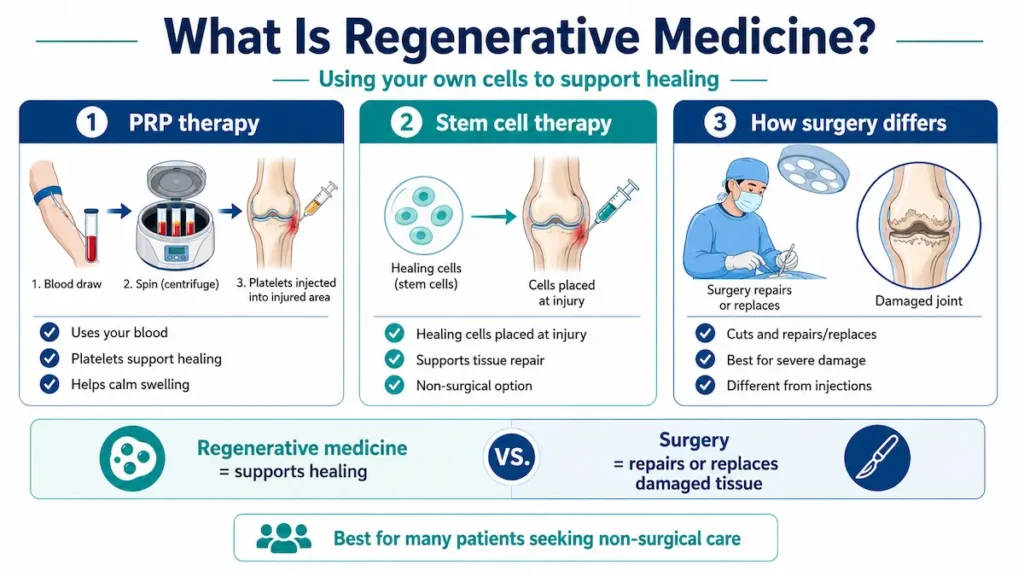
Regenerative medicine uses your own cells to heal damaged tissue. It works two main ways, and our Alpharetta, GA team offers both.
PRP therapy draws a small amount of your blood. A machine spins it to pull out the platelets. Those platelets go back into the injured area. They speed up healing and calm swelling.
Stem cell therapy places healing cells right at the site of the injury. These cells can grow into new tissue over time. Patients who search for non-surgical alternatives often start with one of these two treatments at our clinic.
Surgery works a different way. A surgeon cuts, removes damaged tissue, and repairs or replaces it. Regenerative medicine can’t do that job. A torn ligament won’t regrow on its own. A joint with no cartilage left needs a new surface, not an injection. Learn more on our regenerative medicine page.
Which Option Fits Your Condition?
The right choice depends on which joint you’re treating and how much damage you have. Our Alpharetta, GA clinic sees these four conditions most often.
Knee Osteoarthritis
Early knee arthritis responds well to PRP and stem cell shots. These shots calm swelling and support the cartilage you still have. Bone-on-bone knee arthritis is different. Once the cushion is gone, injections have nothing left to help. Joint replacement works better at that stage.
Rotator Cuff Injuries
A partial rotator cuff tear often heals with regenerative shots and physical therapy. A full tear with a pulled-back tendon needs surgery instead. A surgeon has to reattach the tendon to the bone. An injection can’t do that.
Spine and Disc Conditions
Mild disc bulges and early disc wear often improve with regenerative care. Some symptoms mean you need surgery right away. Numbness, weakness, or loss of bladder control are red flags. Call your doctor the same day if you notice these signs.
ACL and Meniscus Tears
A partial meniscus tear in a stable knee often responds to regenerative therapy. A complete ACL tear in an active patient usually needs reconstruction surgery. Waiting too long on a full rupture raises your risk of more joint damage.
When Surgery Is Still the Right Call
Some injuries need surgery no matter how well you’d respond to regenerative care. Our Alpharetta, GA team will tell you honestly when surgery is the better path, even though we specialize in regenerative treatment.
- A complete ligament or tendon tear
- Bone-on-bone arthritis with no cushion left
- A joint that feels loose or unstable
- A fresh fracture
- An active infection in the joint
- Nerve symptoms like numbness or weakness
If you have any of these signs, ask your doctor for a surgical referral. Regenerative treatment won’t fix a problem that needs a mechanical repair.
When Non-Surgical Alternatives Are Worth Trying First
Other injuries respond well to regenerative care before surgery even comes up. RegenHaus Medical evaluates each Alpharetta, GA patient against this list before recommending a plan.
- A partial tear with healthy tissue around it
- Early or moderate arthritis
- Ongoing tendon pain that hasn’t responded to rest
- A mild disc bulge without nerve symptoms
- Extra support after a past surgery
These treatments fall under FDA oversight.
Self-Assessment Checklist: Which Path Fits You?
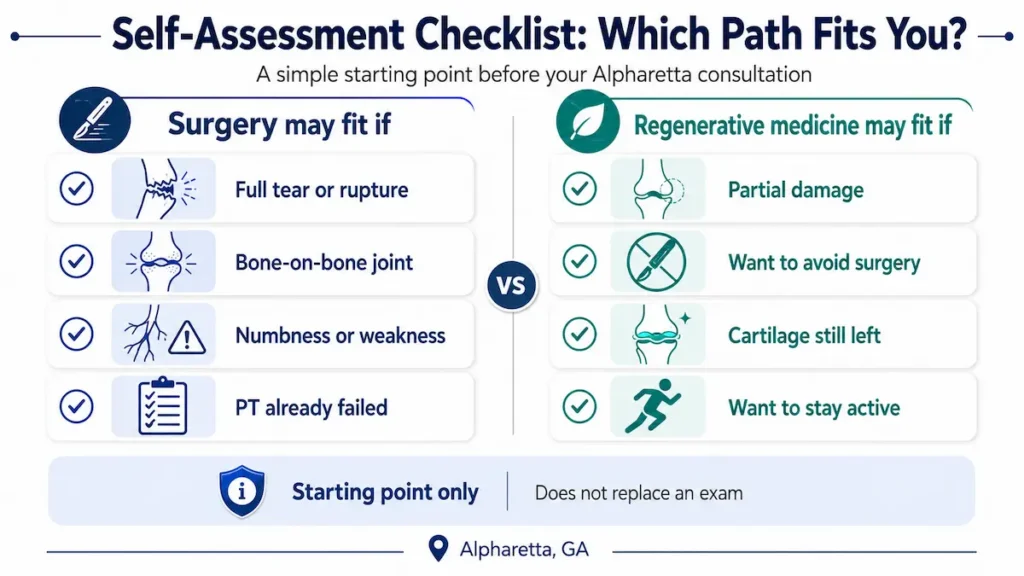
Use this checklist before your consultation at our Alpharetta, GA office. It won’t replace an exam, but it gives you a starting point.
Surgery fits you if:
- You have a full tear or rupture
- Your joint is bone-on-bone
- You have numbness or weakness
- Physical therapy already failed to help
Regenerative medicine fits you if:
- Your damage is partial, not complete
- You want to avoid surgery and its long recovery
- Your joint still has cartilage left
- You want to stay active during treatment
Cost and Insurance: What to Expect
Regenerative treatments at RegenHaus Medical in Alpharetta, GA run $700 to $2,500 per session. The exact price depends on the treatment and the area you’re treating.
Surgery costs far more. Joint replacement runs $15,000 to $50,000 before insurance steps in.
Insurance treats these two options differently. Most plans still call PRP and stem cell therapy experimental. That means they rarely pay for it. Surgery gets covered more often, since a doctor can document medical need. This makes surgery cheaper out of pocket for insured patients, even though its full price tag is higher.
Johns Hopkins Medicine reports that 2% to 5% of patients have a complication after knee or hip replacement. Infection and implant failure are the most common ones. That risk is part of why so many Alpharetta, GA patients ask about regenerative options first.
Frequently Asked Questions
Can regenerative medicine help me avoid surgery entirely?
Yes, if your damage is partial and your joint still has cartilage. A complete tear or bone-on-bone arthritis usually still needs surgery.
How long do regenerative medicine results last compared to surgery?
PRP results usually last six months to two years. Stem cell therapy can last longer. Joint replacement surgery lasts fifteen to twenty years before it needs a redo.
Does insurance cover PRP or stem cell therapy?
Most plans call these treatments experimental and won’t pay for them. Surgery gets covered more often when it’s medically needed.
Is regenerative medicine painful, or does it need downtime?
The shot feels like a blood draw. Most patients go back to normal activity within a few days.
Can I combine regenerative treatment with surgery?
Yes. Some patients get a regenerative shot before surgery to calm swelling. Others get one after surgery to help healing.
How do I know which option is right for my injury?
An imaging exam shows how much tissue damage you have. That result points you toward the right treatment. Our Alpharetta, GA team walks you through the images at your visit.
Regenerative Medicine vs Surgery: Getting Started in Alpharetta
RegenHaus Medical in Alpharetta, GA helps you weigh regenerative medicine vs surgery. We use imaging, a physical exam, and your health goals to guide the decision. Our team has treated patients across Alpharetta, GA and the surrounding area, and we’ll give you a straight answer, even if that answer is surgery.
Call (404) 424-4068 to book a consultation and find the right path for your condition.


