
If you’ve been told you need a knee replacement, you’ve probably started reading about regenerative medicine in Atlanta. You want to know one thing: does it work, and does it work for you?
This guide answers that honestly. Some people qualify. Many don’t. RegenHaus Medical in Alpharetta turns patients away every week, and that’s the point of a real consultation.
Joint pain is common here. The CDC reports that 53.2 million American adults, or 21.2 percent, have diagnosed arthritis. Most of them never hear about their non-surgical choices.
TL;DR
- Regenerative medicine uses your own blood or bone marrow to repair joints instead of replacing them.
- PRP has the strongest research support. Exosomes remain investigational.
- Most treatments are cash pay. Your consult and imaging often bill to insurance.
- Good candidates have moderate joint wear. Bone-on-bone joints rarely respond.
- RegenHaus Medical treats patients across Alpharetta, Johns Creek, Roswell, and Milton.
What Is Regenerative Medicine?
Regenerative medicine repairs damaged tissue using healing materials taken from your own body. Doctors concentrate those materials and place them directly into the injured joint or tendon. Nothing artificial goes in.
The phrase means three different things depending on who’s talking. Researchers use it for lab-grown tissue and gene therapy. Med spas use it for skin treatments. Orthopedic clinics like RegenHaus Medical in Alpharetta use it for injections that treat osteoarthritis and tendinopathy.
This page covers the third kind. For a longer version, read our plain-English introduction.
How Does Regenerative Therapy Work in Your Body?
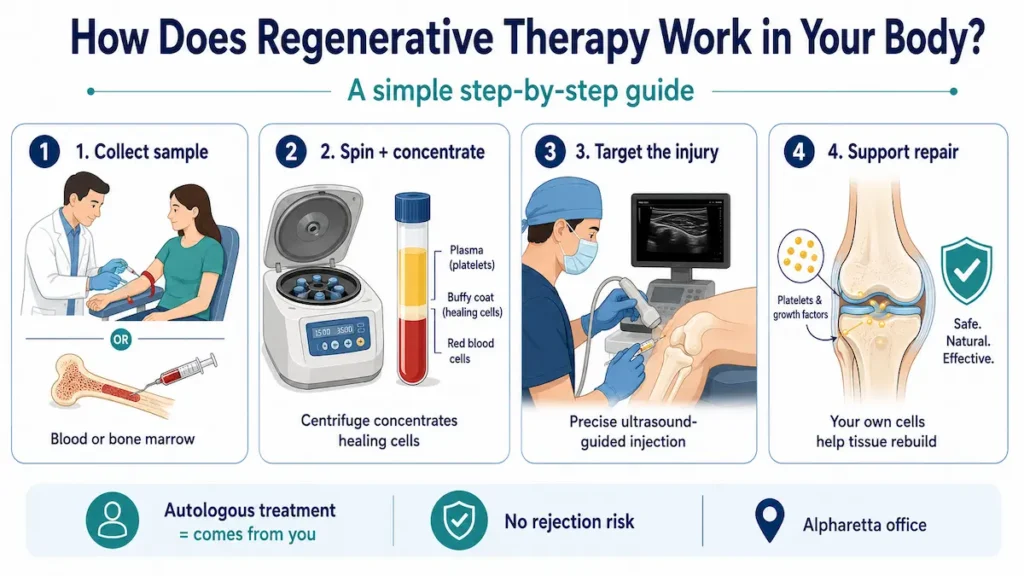
Your blood already carries repair cells. Platelets release growth factors that tell tissue to rebuild. A stalled injury simply isn’t getting enough of them.
Here’s the sequence at our Alpharetta office:
- We draw blood or bone marrow, depending on your joint.
- A centrifuge spins the sample and concentrates the healing portion.
- Your physician injects that concentrate under ultrasound guidance, so the needle lands exactly where the damage is.
Because everything comes from you, rejection isn’t possible. Doctors call this autologous treatment.
Which Regenerative Medicine Treatments Does RegenHaus Medical Offer?
RegenHaus Medical offers four options at our Alpharetta clinic. Your physician picks one based on which tissue is damaged and how far the wear has progressed.
| Treatment | Best for | What happens |
|---|---|---|
| PRP therapy | Knee osteoarthritis, tennis elbow, plantar fasciitis | Blood draw, spin, injection. About an hour. |
| Stem cell therapy | Moderate hip and knee wear, stubborn rotator cuff problems | Bone marrow drawn from the hip, then injected |
| Exosome therapy | Investigational only | Discussed at consult, not offered for joints |
| Prolotherapy | Loose ligaments, sacroiliac pain | Dextrose injections over several months |
Which Regenerative Therapy Has the Strongest Evidence?
PRP (Platelet-Rich Plasma) therapy wins on evidence. Research supports it most strongly for knee osteoarthritis and lateral epicondylitis. Bone marrow concentrate ranks second, with solid short-term results and thin long-term data. Exosome products sit at the bottom.
| Therapy | Evidence | Relief window |
|---|---|---|
| PRP | Strong | 6 to 12 months |
| Bone marrow concentrate | Moderate | Up to 6 months, longer for some |
| Prolotherapy | Limited but positive | Varies by ligament |
| Exosomes | Investigational | No reliable data |
Our Alpharetta physicians say this out loud because clinics that grade every service as excellent aren’t grading anything.
Who Is a Good Candidate for Regenerative Medicine in Alpharetta?
The best candidates still have joint space left on X-ray. Once a joint goes bone-on-bone, injections rarely help, and RegenHaus Medical will tell you so before you pay anything.
You’ll likely do well if you:
- Have moderate wear in a hip, knee, shoulder, ankle, or thumb
- Tried physical therapy or cortisone without lasting relief
- Want to delay joint replacement
- Don’t smoke and stay reasonably active
Injections aren’t right for you if you:
- Have an active infection anywhere in the body
- Had blood cancer within the past five years
- Take high-dose blood thinners
- Show complete joint collapse on imaging
- Live with uncontrolled diabetes or an untreated thyroid problem
Your Alpharetta consult includes an X-ray review, so nobody guesses.
What Does Regenerative Medicine Cost in Atlanta?
Pricing depends on the joint and the therapy. Call RegenHaus Medical at (404) 424-4068 for current figures.
[CLIENT INPUT NEEDED: insert real price ranges per modality before publishing.]
Insurance handles more of this than people expect. Your office visit, physical exam, X-rays, and MRI review usually bill to your plan. The injection itself is cash pay, because insurers class these biologics as investigational. Patients across Johns Creek and Roswell frequently use HSA funds or financing to cover the difference.
Is Regenerative Medicine FDA Approved?
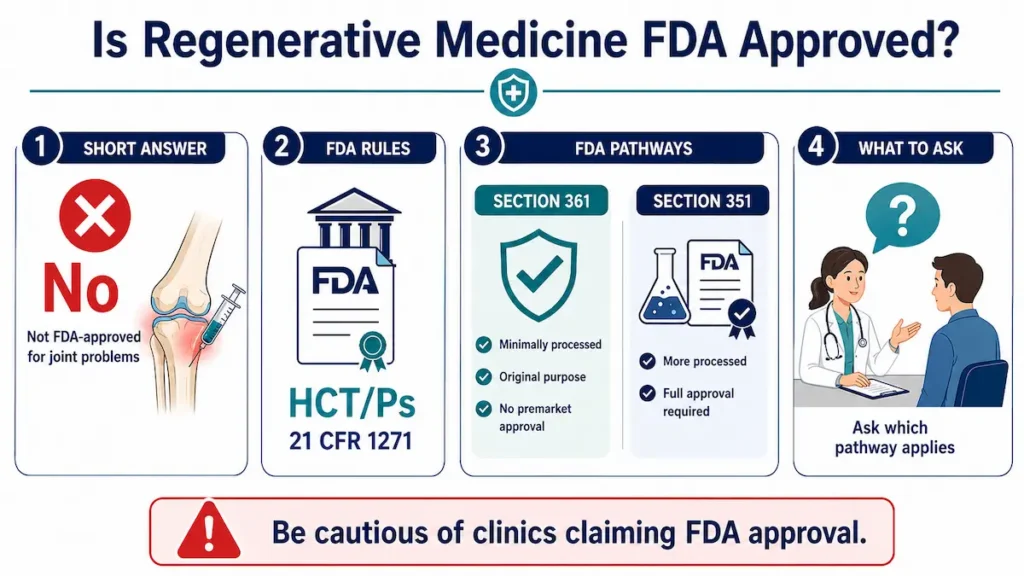
No. The FDA hasn’t approved these injections for joint problems, and any Atlanta clinic claiming otherwise is misleading you.
Here’s what actually governs it. The agency regulates these products as HCT/Ps under 21 CFR 1271. Two pathways exist:
- Section 361 covers minimally processed tissue used for its original purpose. No premarket approval required.
- Section 351 covers heavily processed products. Full approval required, the same as a new drug.
The FDA ended its enforcement grace period, and federal regulators have pursued clinics selling unapproved cell products. Ask any provider which pathway their materials fall under. RegenHaus Medical answers that question at every Alpharetta consultation.
How Do You Choose a Regenerative Medicine Clinic?
Ask these six questions. Good answers sound specific. Bad answers sound like marketing.
- Which FDA pathway do your products fall under? A real clinic names 361 or 351 and explains why.
- Do you inject under ultrasound? Blind injections miss the target often enough to matter.
- Who holds the needle? It should be a physician, never a technician.
- How often do you turn patients away? Zero is a warning sign.
- Do you require imaging first? Treating a joint nobody imagined is guessing.
- Are you selling a package today? Pressure to prepay for six sessions signals sales, not medicine.
Every clinic in Alpharetta should survive that list, including ours.
What Happens on Treatment Day?
Plan for two hours at our Alpharetta office. You’ll sign consent, then your physician draws blood or bone marrow from the back of your hip.
Processing takes roughly 15 minutes while you wait. The injection follows, guided by ultrasound.
Expect soreness for two or three days afterward. That reaction is the healing response starting, and it fades. Arrange a ride home. Most patients notice change around week four, with continued gains through month three.
Frequently Asked Questions
Does regenerative medicine hurt?
The bone marrow draw stings briefly. Soreness lasts two to three days afterward.
How many sessions will I need?
PRP often works best as a series of three. Bone marrow treatment usually requires one.
Will this regrow my cartilage?
Limited research shows partial cartilage change. Pain relief happens whether cartilage changes or not.
Is PRP the same as stem cell therapy?
No. PRP comes from blood. Stem cell treatment comes from bone marrow or fat.
Am I too old for this?
Age matters less than joint condition. Our oldest Alpharetta patients do well when imaging looks right.
What if it doesn’t work?
Your physician reviews other options, including surgical referral. Nobody at RegenHaus Medical pretends injections fix everything.
Talk to a Physician in Alpharetta
Regenerative medicine in Atlanta works for the right joint at the right stage. Finding out takes one honest conversation and one X-ray.
Call RegenHaus Medical at (404) 424-4068 to book a consultation in Alpharetta. We’ll review your imaging, explain which therapy fits, and tell you plainly if none of them do.


